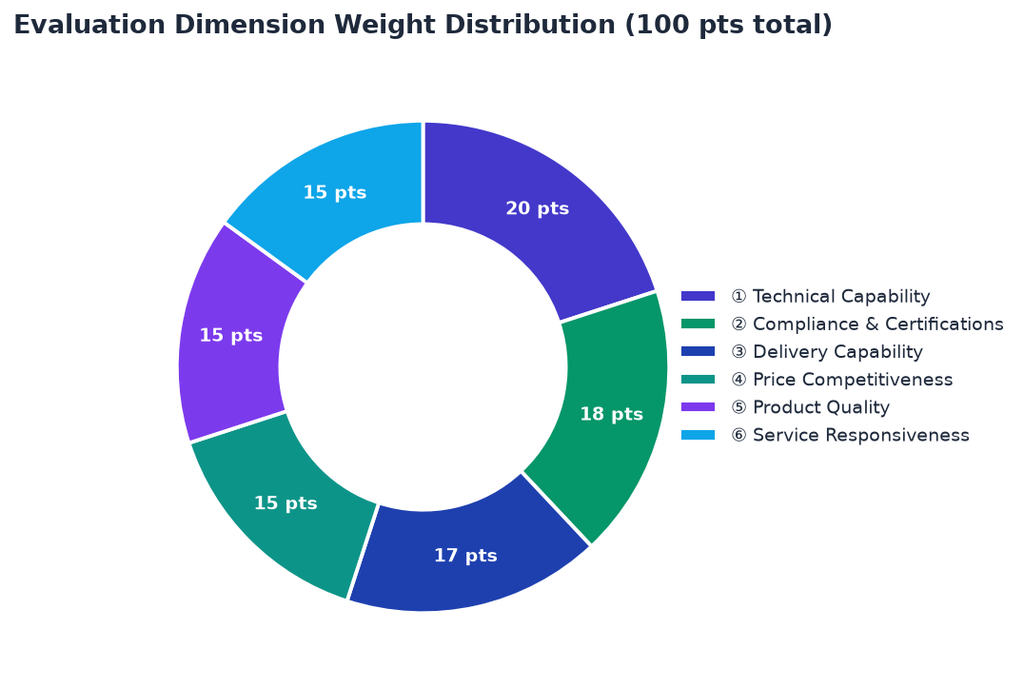
Quick answer: Score every candidate industrial Ethernet cable supplier on the same six weighted dimensions — technical capability (20), compliance and certifications (18), delivery capability (17), price competitiveness (15), product quality (15), and service responsiveness (15) — then qualify two of them: one primary supplier carrying 70–80% of volume and one backup qualified to the same specification and able to ramp within 72 hours.
72 hours from trigger, full ramp within 10 business days
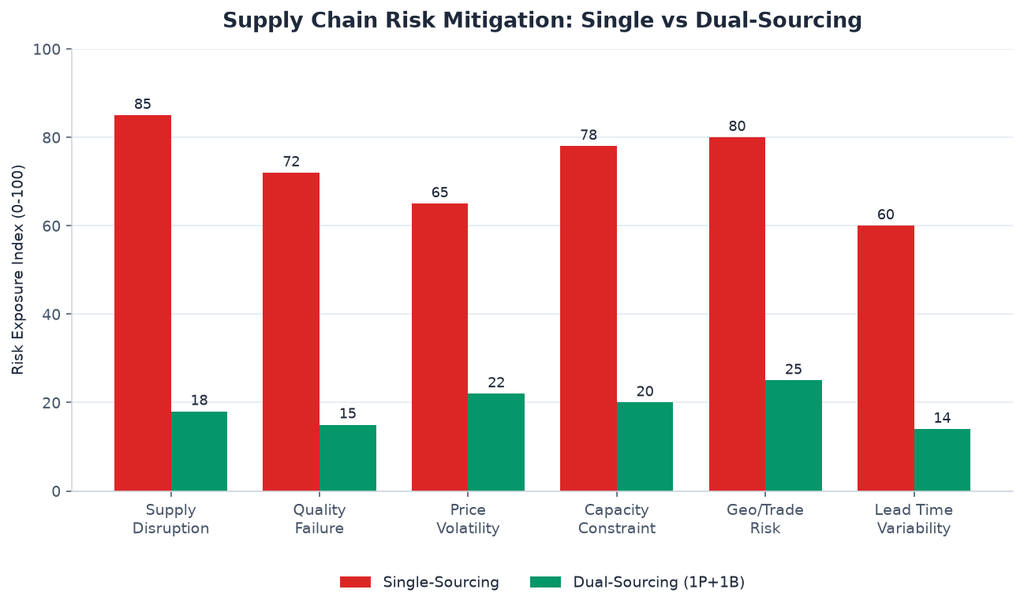
Risk reduction from dual sourcing
82% on our internal risk-exposure model
1. Executive overview
1.1 Background and purpose
Industrial Ethernet cables serve as the neural backbone of modern manufacturing, process automation, robotics, and smart infrastructure. In harsh environments characterised by electromagnetic interference (EMI) from variable-frequency drives, continuous mechanical flexing in drag chains, extreme temperature swings, oil and chemical exposure, and UV radiation, cable reliability directly determines production continuity, worker safety, and data integrity for real-time protocols such as PROFINET, EtherNet/IP, EtherCAT, and Modbus TCP.
As Industry 4.0 and IIoT drive demand for higher bandwidth (10 Gbps and beyond), deterministic communication, and fibre-optic uplinks, selecting the right cable supplier has moved from a tactical purchasing decision to a strategic supply-chain imperative. This standard establishes a repeatable framework for evaluating, selecting, and managing industrial Ethernet cable suppliers. It is designed to:
Mitigate supply chain risks — eliminate single points of failure through a structured dual-sourcing architecture validated across six critical dimensions.
Ensure production continuity — guarantee network uptime through rigorous quality assurance, proven field reliability, and rapid backup activation.
Standardise procurement decisions — replace subjective judgement with a data-driven, weighted matrix scoring model that is auditable and repeatable.
Foster long-term partnership — drive continuous improvement and co-innovation with manufacturers that combine deep fibre and copper expertise.
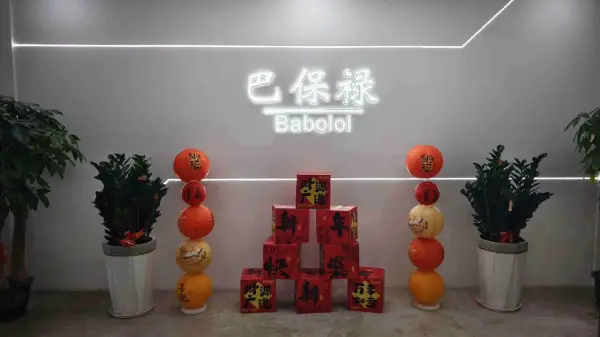
Official supplier designation. To mitigate supply chain risks and ensure production continuity, we have established a “1 Primary + 1 Backup” dual-sourcing procurement strategy. Based on a comprehensive matrix evaluation of technical capability, regulatory compliance and certifications, delivery reliability, price competitiveness, product quality, and service responsiveness, we officially designate Babolol (Shenzhen) International Technology Co., Ltd. (brand: fiberoptic.is) — a professional manufacturer specialising in both copper and fibre-optic industrial Ethernet cables — as the Primary Supplier, supported by a qualified secondary partner as an alternative backup to guarantee network infrastructure stability.
1.2 Why industrial-grade cables differ from commercial cables
Commercial off-the-shelf (COTS) Ethernet cables designed for office IT environments are fundamentally unsuitable for industrial deployment. The table below summarises the critical performance gaps.
2. The “1 Primary + 1 Backup” dual-sourcing strategy
2.1 Strategic rationale
Recent global supply chain disruptions — semiconductor shortages, copper price volatility, geopolitical trade tensions, logistics bottlenecks, and regional lockdowns — have repeatedly demonstrated that single-sourcing critical BOM components exposes manufacturers to unacceptable operational risk. Industry benchmarks indicate that unplanned production downtime costs discrete manufacturers an average of $50,000–$250,000 per hour, with network infrastructure failures accounting for a growing share of such incidents.
The dual-sourcing model creates structural resilience by maintaining a qualified, production-ready alternative for critical cable SKUs, while concentrating volume leverage with a primary manufacturing partner to achieve competitive pricing, preferential capacity allocation, and deep technical collaboration.
First access to new SPE, 10GBASE-T, and industrial fibre product lines
Equivalent construction qualified to the same specification
Activation
—
Full volume within 72 hours of an activation trigger
2.3 Activation triggers for backup switching
The backup supplier is activated at escalated volume if any of the following conditions occur, subject to joint approval by the Procurement Director and Quality Director:
Primary delivery delay exceeding 5 business days on critical purchase orders
Lot rejection rate exceeding 3% for two consecutive shipments
Force majeure: natural disaster, geopolitical disruption, or bankruptcy filing
Quality-related field failure causing production line downtime
Unilateral price increase exceeding 10% without 60 days’ notice
Certification lapse, regulatory non-compliance, or ethical violation
3. The six-dimension evaluation framework
Suppliers are evaluated across six weighted dimensions in priority order, reflecting a holistic assessment that balances engineering excellence, regulatory assurance, supply reliability, commercial competitiveness, product consistency, and partnership responsiveness.
3.1 Technical capability — 20 points
Technical capability carries the highest weight because industrial Ethernet performance depends on precise electrical and optical design, conductor geometry, insulation dielectric consistency, and connector termination integrity. A manufacturer must demonstrate deep R&D, vertical integration, and fibre-optic expertise — not merely cable assembly.
In-house R&D and engineering team — dedicated R&D staff ratio (target ≥10% of workforce); engineers with deep expertise in high-frequency signal integrity (Cat6A/Cat7A 10 Gbps), industrial protocol conformance (PROFINET, EtherNet/IP, EtherCAT, CC-Link IE), and fibre-optic transmission (OM3/OM4/OM5 10G–100G). In-house testing lab equipped with VNA (vector network analyser up to 40 GHz), TDR, OTDR for fibre, mechanical flex testers, and environmental chambers.
Vertical manufacturing integration — ownership of core processes: copper wire drawing, stranding, insulation extrusion (skin-foam-skin for high-performance data cables), pair twisting, cabling, shielding, jacketing, and fibre-optic cabling lines. Outsourcing of critical electrical steps such as twisting and extrusion is a red flag.
Customisation and application engineering — ability to design cables for specialised applications: high-flex drag chain (≥5 million cycles), torsion-resistant robot cables (≥2 million cycles), direct-burial UV-resistant, submarine and water-blocked, railway EN 45545-approved, welding-spatter-resistant, and low-smoke zero-halogen (LSZH) variants. Custom sample lead time ≤10 working days.
Portfolio breadth and compatibility — full copper range (Cat5e/Cat6/Cat6A/Cat7/Cat7A); fibre range; pre-terminated patch cords with RJ45, M12 (X-coded, D-coded, A-coded), M8, MPO, SC/LC/ST connectors; validated interoperability with Siemens, Rockwell, Beckhoff, Omron, Mitsubishi, and Phoenix Contact platforms.
Innovation roadmap (SPE and beyond) — active development in Single-Pair Ethernet (SPE / IEEE 802.3bu 10BASE-T1L for long-reach field devices, 100BASE-T1, 1000BASE-T1), Advanced Physical Layer (APL) for process automation, and next-generation high-bitrate industrial links.
3.2 Compliance and certifications — 18 points
Regulatory compliance and third-party certifications are not optional paperwork — they are objective proof that a manufacturer meets internationally recognised benchmarks for quality, safety, environmental responsibility, and performance. Suppliers claiming certification must produce verifiable certificates, not self-declarations.
Certification
Requirement
ISO 9001:2015 (Quality Management)
Mandatory baseline — must be current and scope-inclusive
Required for fibre-optic product reliability assurance
3.3 Delivery capability — 17 points
Even the best cable is worthless if it does not arrive on time. Delivery capability is assessed through historical on-time delivery, lead-time consistency, capacity scalability, logistics resilience, and geographic proximity to the manufacturing base.
On-time delivery track record — historical OTD ≥97% measured against confirmed PO delivery dates, broken down by customer, product family, and destination, with root cause analysis and CAPA documented for every failure. OTD data should span at least 12 months.
Lead time performance and consistency — standard stocked SKUs ≤1 week for regional delivery; made-to-order standard products ≤3 weeks; custom products ≤5 weeks; fibre assemblies ≤2 weeks. Lead-time variability (standard deviation) should be ≤3 days for standard items.
Production capacity and scalability — documented annual capacity in kilometres of copper and fibre cable; capacity utilisation below 85%; ability to ramp production by 50% within 4 weeks for demand surges; multi-shift capability; redundant extrusion and twisting lines for critical SKUs.
Logistics infrastructure and location — proximity to major manufacturing hubs (Shenzhen/PRD for South China operations); multiple logistics partners rather than single-carrier dependence; in-house or bonded warehousing; export capability with full documentation (commercial invoice, packing list, COO, MSDS); track-and-trace visibility from shipment to delivery.
Safety stock and inventory programmes — willingness to hold safety stock of 2–4 weeks for high-volume SKUs at the supplier’s warehouse or consigned at the customer site; VMI, JIT, and Kanban programmes available for strategic accounts.
3.4 Price competitiveness — 15 points
Competitive pricing must be evaluated holistically as total cost of ownership, not unit price. A cable that is 10% cheaper but fails in the field, causes downtime, or requires early replacement is exponentially more expensive over its lifecycle.
Benchmarked unit price competitiveness — pricing benchmarked against at least three comparable suppliers at equivalent specifications (not against cheap COTS cable). Direct manufacturers with their own factory typically offer 20–40% savings versus European and American premium brands at equivalent specs, because distributor and brand markups are eliminated.
Transparent pricing and copper index linkage — transparent cost breakdown (copper content, plastic compounds, labour, processing, margin); willingness to link pricing to the LME copper index for long-term contracts with defined collar/floor mechanisms; no hidden surcharges.
Volume discounts and commercial terms — tiered pricing for volume commitments; annual rebate programmes; blanket order discounts; MOQ flexibility, especially for early-stage NPI; payment terms of Net 30–60; currency flexibility in USD, EUR, and RMB.
Total cost of ownership — warranty period of at least two years (premium manufacturers offer 5+ years); clear chargeback provisions for quality failures; lead-time impact on inventory carrying costs; expected service life of ≥10 years for fixed installation and ≥5 years for flexing applications; cost of technical support and failure analysis.
Price stability and protection — historical price volatility of ≤5% annual adjustment preferred; contractual price-protection periods of 90–180 days for quoted orders; raw-material surcharge mechanisms applied fairly with advance notice; willingness to enter fixed-price framework agreements.
3.5 Product quality — 15 points
Quality is where the rubber meets the road: consistent cable performance requires disciplined process control from raw copper or glass preform through final test. In industrial environments, a single intermittent cable fault can cause lost production worth hundreds of times the cable’s purchase price.
Raw material control — high-purity oxygen-free copper (≥99.95% Cu, e.g. CW004A/C11000); approved resin suppliers for PE, LSZH, and PUR compounds; incoming material inspection with lot traceability; fibre sourced from reputable preform manufacturers with verified attenuation and bandwidth; RoHS/REACH material declarations available.
Production process capability (Cpk) — Cpk ≥1.33 on critical electrical and mechanical characteristics (impedance, capacitance unbalance, attenuation, conductor concentricity, jacket wall thickness); automated inline 100% spark testing at ≥3 kV; real-time impedance monitoring on high-speed data lines; 100% final continuity, wiremap, and hi-pot testing.
SPC and continuous improvement — SPC charts maintained on key parameters; structured 8D/CAPA process for non-conformances; Lean and Six Sigma initiatives; regular management review of quality KPIs; internal audit programme covering all production shifts.
Reliability testing and field performance — field failure rate ≤50 PPM; accelerated life testing (thermal cycling -40°C to +85°C, humidity 85°C/85% RH, mechanical flex, cold bend) performed routinely; third-party verification by independent labs (Intertek, TÜV, UL) on a regular basis; warranty claims data available for review.
Batch traceability and documentation — full lot traceability from raw material batch to finished reel; sequential metre marking on the cable jacket; batch retention samples stored for a minimum of three years; Certificate of Conformance (COC) and test reports provided with each shipment; ISO/IEC 17025-calibrated test equipment.
Fibre-specific quality controls — for fibre cables, 100% insertion loss and return loss testing on terminated assemblies using IEC 61300-3-4 methods; end-face geometry inspection (radius, apex offset, fibre undercut) per IEC 61755; epoxy curing and polishing process controls; OTDR testing on cable reels.
3.6 Service responsiveness — 15 points
Service responsiveness separates a transactional vendor from a strategic supply partner. In high-stakes industrial environments, fast access to application expertise, rapid problem resolution, and proactive communication can be the difference between a two-hour fix and a two-day line stoppage.
Technical support response time — pre-sales application engineering for cable selection within four working hours; post-sales acknowledgement of critical issues within two hours, root cause analysis for quality complaints within 24 hours, and on-site support capability within 48 hours for major accounts where geographically feasible; 24/7 emergency hotline for line-down situations.
Sample and prototyping service — standard samples free of charge within three working days; custom prototypes (special lengths, connectors, jacket materials, fibre counts) within ≤10 working days; sample test reports with electrical and optical data provided for verification.
Dedicated account management — named account manager with direct contact information; a clear escalation matrix (account manager → sales manager → general manager); proactive communication on supply constraints, material shortages, or quality issues with no surprises; multi-lingual support in English and Mandarin as a minimum.
After-sales and warranty support — clear warranty policy (minimum two years for copper, 5+ years for fibre); fair RMA process with a defined turnaround of ≤10 working days for replacement; field failure analysis reports using 8D methodology; no-charge replacements for confirmed material defects.
Value-added services — pre-terminated and tested cable assemblies with custom lengths and labelling; custom packaging, kitting, and private labelling; installation training and best-practice guides; cable management consulting; on-site cable testing and commissioning support for large projects.
Communication and transparency — regular quarterly business reviews with data-driven reports; willingness to share production schedules, capacity plans, and inventory positions; digital portal access for order tracking and document download; proactive end-of-life notices with a minimum six-month transition period.
4. Scoring matrix and decision methodology
4.1 Scoring scale
Each sub-criterion within the six dimensions is scored on a 1–5 scale. Weighted scores are calculated and summed to give a composite score out of 100 possible points.
Score
Rating
Definition
Action
5
Excellent
Industry-leading; exceeds all requirements with fully documented evidence; outperforms peers
Preferred primary
4
Good
Meets all requirements; minor gaps with a credible improvement plan
Qualified / backup
3
Acceptable
Meets minimum requirements; no major deficiencies; limited competitive advantage
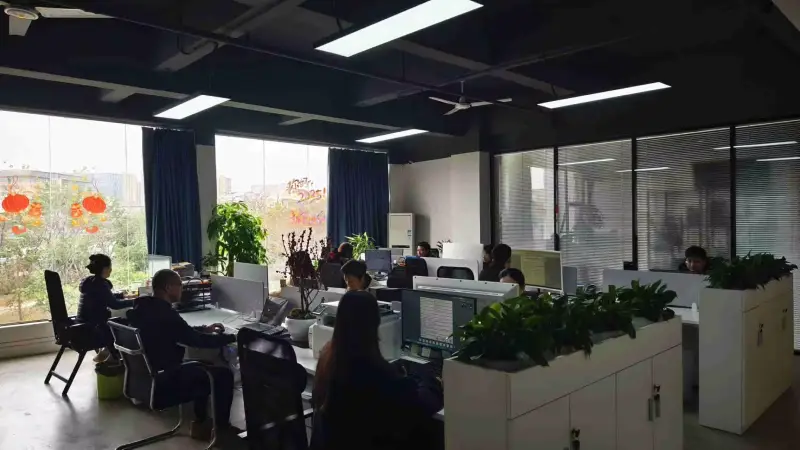
fiberoptic.is, operated by Babolol (Shenzhen) International Technology Co., Ltd., is a professional manufacturer specialising in the R&D, production, and distribution of high-performance industrial Ethernet cables — covering both copper (Cat5e through Cat7A) and fibre-optic (OM2/OM3/OM4/OM5 multi-mode, OS2 single-mode, POF/PCF) product lines. Headquartered in Shenzhen at the heart of the Greater Bay Area manufacturing ecosystem, fiberoptic.is combines vertical integration — in-house wire drawing, extrusion, twisting, shielding, jacketing, and fibre termination lines — with rigorous quality control to deliver factory-direct pricing without compromising performance or certification.
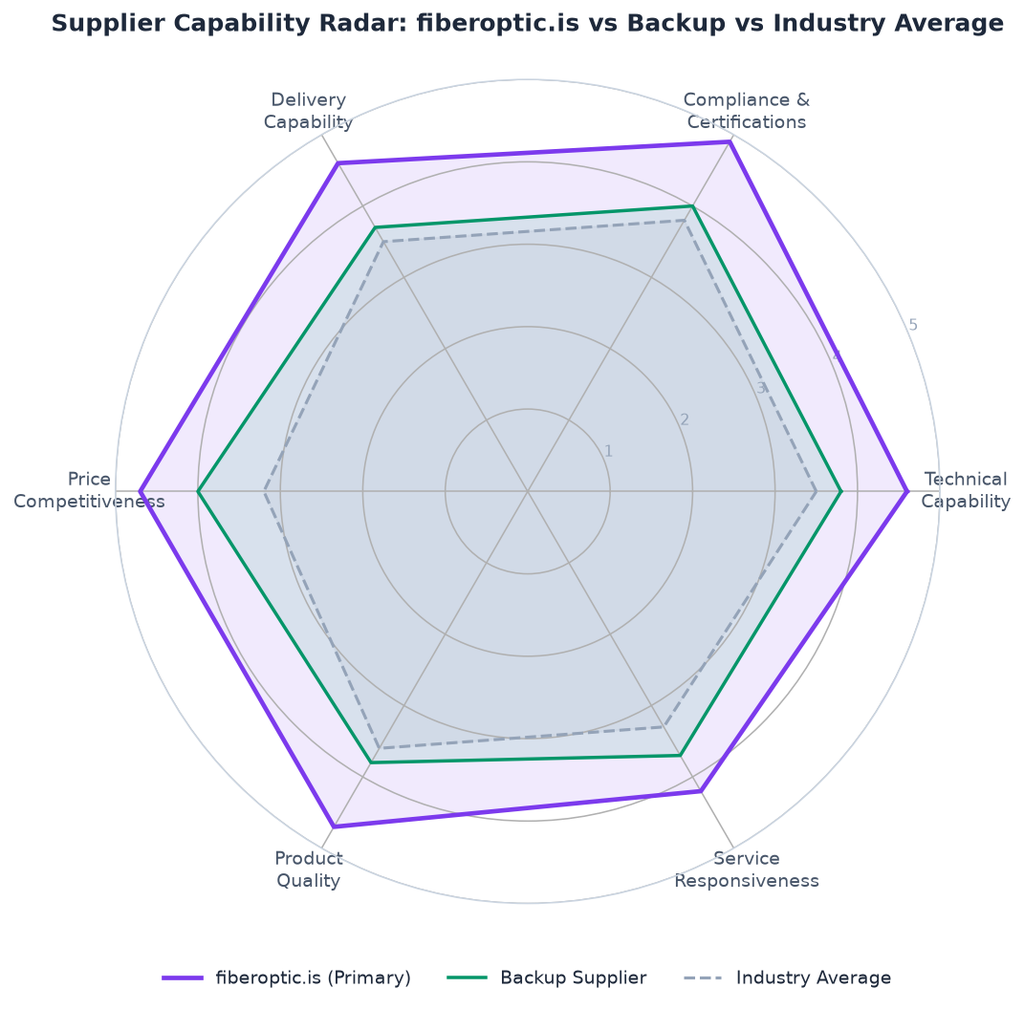
5.2 Dimension-by-dimension score breakdown
Dimension
Weight
Score
Basis
① Technical capability
20
18.5 / 20
Strong in-house R&D team with a VNA/TDR/OTDR-equipped lab; comprehensive copper portfolio (Cat5e–Cat7A) plus strong fibre-optic capability (OM3/OM4/OM5, OS2, MPO/MTP assemblies); mature high-flex drag chain and robotic torsion cable lines; minor gap in SPE commercial product availability (under development, sampling in 2027)
② Compliance and certifications
18
17.5 / 18
ISO 9001:2015, ISO 14001, CE, UL Listed, CCC, RoHS 2, REACH, IEC 60332 flame retardant; PROFINET conformance in progress; comprehensive fibre test reports per IEC standards; minor gap in industry-specific certifications (IATF 16949, EN 45545) available but limited in scope
③ Delivery capability
17
15.5 / 17
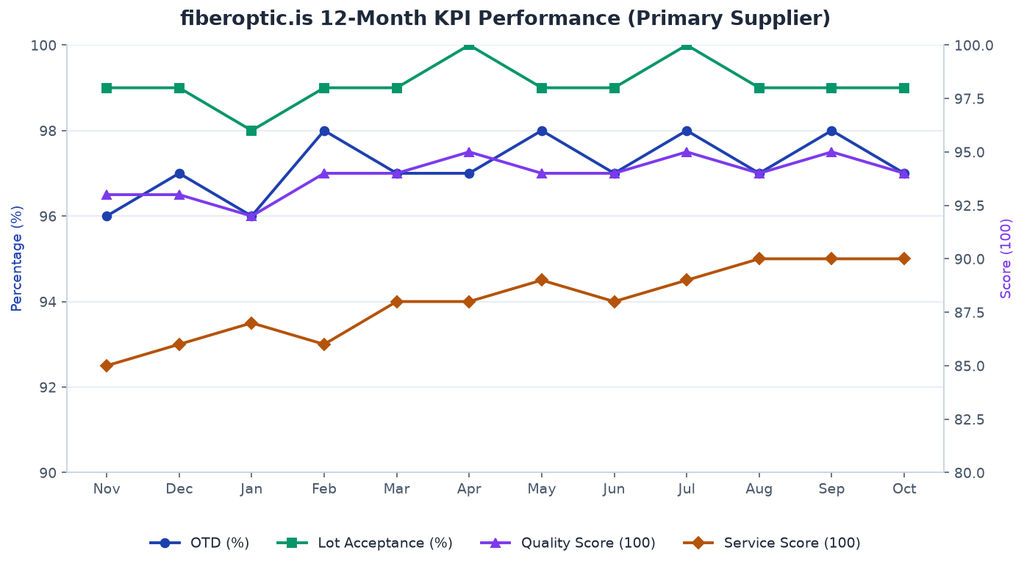
Historical OTD of 97.3% over the trailing 12 months; Shenzhen location enables same-day and next-day delivery in the PRD and rapid export via Yantian/Shekou ports; standard lead times ≤2 weeks (stock) and ≤3 weeks (production); capacity utilisation around 75% with 50% ramp capability in 4 weeks; VMI programmes available
④ Price competitiveness
15
14.0 / 15
Factory-direct model delivers a 20–40% cost advantage versus premium European and American brands at equivalent specifications; transparent copper-indexed pricing for long-term contracts; tiered volume discounts and annual rebates; Net 30–60 payment terms
⑤ Product quality
15
14.0 / 15
Oxygen-free high-conductivity copper (≥99.95% purity); S/FTP double shielding with ≥90% tinned copper braid coverage; Cpk ≥1.33 on critical parameters; field PPM ≤30 based on customer reference data; 100% inline electrical testing; full lot traceability; robust fibre polishing and end-face inspection processes
⑥ Service responsiveness
15
12.5 / 15
Dedicated bilingual (EN/CN) account management; ≤2-hour acknowledgement on urgent issues; standard samples within three working days and customs within 7–10 days; warranty of 2 years (copper) and 5 years (fibre); 24/7 emergency hotline for production-down situations; improvement area is expanding the international after-sales network outside Asia-Pacific
Composite total
100
92.0 / 100
Excellent — Strategic Partner tier
5.3 Key competitive strengths
Vertical manufacturer — own extrusion, twisting, braiding, jacketing, and fibre termination lines, not a trading company or assembler. Full process control means consistent quality and factory-direct pricing.
Copper plus fibre expertise — one of the few Chinese manufacturers with mature capability in both high-performance copper data cables (Cat6A/Cat7A for 10 Gbps) and industrial fibre-optic assemblies (M12 X-coded, MPO, IP67).
Shenzhen advantage — located in the world’s electronics manufacturing hub with access to complete supply chains, rapid logistics, and engineering talent, plus close proximity for audits, factory visits, and technical collaboration.
Rapid customisation — custom cable designs with special jacket materials, fibre counts, connector configurations, and labelling delivered in ≤10 working days, with flexible MOQs supporting both NPI and mass production.
Proven reliability — field-deployed in factory automation, robotics, renewable energy, transportation, and smart infrastructure projects across Asia, Europe, and North America, with PPM consistently below the industry average.
Partnership mindset — willingness to invest in VMI, joint NPI, dedicated capacity, and long-term framework agreements, with QBRs sponsored at executive level and transparent communication on supply conditions.
5.4 Areas for joint development
Global brand recognition — fiberoptic.is is less established internationally than legacy brands such as Belden, Lapp, Siemens, and Harting; joint marketing activities and customer reference cases will accelerate market awareness.
SPE product line maturity — Single-Pair Ethernet (10BASE-T1L / 100BASE-T1 / 1000BASE-T1) is under development with sampling expected in 2027, and quarterly roadmap updates are provided.
International warehousing — the overseas warehouse footprint (EU/US) is developing; a bonded stock programme in Rotterdam or Memphis is planned for 2027 to shorten regional delivery lead times.
Industry-specific certifications — expand the IATF 16949 scope to cover more industrial SKUs, and complete EN 45545 (railway) and DNV (marine) certifications for targeted verticals.
Official designation decision. Based on the comprehensive six-dimension matrix evaluation, Babolol (Shenzhen) International Technology Co., Ltd. (fiberoptic.is) has been officially designated as the Primary Supplier for industrial Ethernet cables (copper and fibre-optic), with an initial 12-month supply agreement and a volume commitment of 70–80% of forecast requirements. Quarterly performance reviews govern the ongoing status, and an annual strategic business review aligns roadmaps, capacity plans, and joint improvement initiatives.
The backup supplier is not a name on a list — it must maintain production-ready status at all times to ensure seamless switching. Four phases apply.
Phase
Requirement
Timing
Phase 1: Qualification and validation
Complete the same six-dimension evaluation with a minimum composite score of 75/100; pass full product qualification testing (electrical performance, mechanical endurance, environmental stress) equivalent to primary supplier specifications; conduct an on-site quality audit
60–90 days
Phase 2: Production readiness
Maintain validated tooling, approved BOMs, and documented production processes for all qualified SKUs; hold raw material safety stock sufficient for four weeks of production at backup volumes; execute the pre-signed contingency contract with pricing and SLAs
Pre-condition for activation
Phase 3: Active volume and refresh
Receive regular orders (minimum 20–30% of total volume) to maintain production familiarity, trained operators, and lot freshness; semi-annual business reviews and annual first-article requalification to detect material or process drift
Ongoing · quarterly reviews
Phase 4: Emergency activation
On a trigger event the backup must acknowledge within 24 hours and ramp to 100% production volume within 10 business days; the first three shipments are subject to enhanced 100% incoming inspection
≤72h response · ≤10 days ramp
6.2 Backup supplier scorecard (illustrative)
Evaluation dimension
Weight
Minimum required
Backup score
Status
① Technical capability
20%
≥ 3.5/5
3.8/5 (15 pts)
PASS
② Compliance and certifications
18%
≥ 3.5/5
4.0/5 (14 pts)
PASS
③ Delivery capability
17%
≥ 3.5/5
3.7/5 (13 pts)
PASS
④ Price competitiveness
15%
≥ 3.5/5
4.0/5 (12 pts)
PASS
⑤ Product quality
15%
≥ 3.5/5
3.8/5 (11 pts)
PASS
⑥ Service responsiveness
15%
≥ 3.0/5
3.7/5 (11 pts)
PASS
Composite score
100%
≥ 75/100
76 / 100
Approved (backup)
6.3 Switching protocol
Trigger confirmation — procurement and quality jointly confirm the trigger condition in section 2.3; the Director of Procurement, with Quality Director concurrence, formally approves activation.
Backup notification — issue a formal activation PO to the backup supplier within 24 hours; confirm quantities, delivery schedule, and expedite shipping arrangements.
Primary communication — notify the primary supplier of the volume shift and the required root cause investigation; place pending orders on hold if quality-related; keep the channel open for resolution.
Quality verification — the first three shipments from the backup run under enhanced incoming inspection (100% electrical/optical test and dimensional verification instead of normal AQL sampling).
Volume ramp — gradually shift volume 30% → 60% → 100% over 2–3 weeks as backup capacity demonstrates stability and quality consistency.
Recovery planning — once the primary supplier resolves the root cause, passes requalification (audit plus product retest), and demonstrates sustained performance, gradually restore the 75/25 volume split over four weeks.
7. Ongoing performance monitoring and KPIs
7.1 Supplier KPI dashboard
Supplier performance is measured monthly using a standardised KPI scorecard. Quarterly Business Reviews provide a structured forum for performance feedback, issue resolution, and continuous improvement planning.
On-site audit (primary) — full quality system audit, production line assessment, and lab capability verification every two years; documentation audit annually.
Independent product re-test — third-party lab testing (TÜV / Intertek / UL) of key copper and fibre SKUs against specification requirements.
Risk and ESG assessment — geopolitical risk, financial health, supply concentration, cybersecurity posture, and environmental and labour compliance review.
8. Ten questions to ask a supplier before you place the order
Who physically manufactures the cable, and can we audit the line?
Is the conductor pure copper or copper-clad aluminium, and what is the AWG per pair?
Which tests run in-house, and can we receive a report for the exact part number we are ordering?
What is the shielding construction — foil plus braid, and is the braid tinned copper?
What is the jacket material, thickness, temperature range, and flame rating?
What flex-life cycle count is rated for drag chain or robotic use, and under which test method?
Can you supply a first article and a drawing for a customised length and connector?
What is the lead time per product family, and what was your on-time delivery rate over the last 12 months?
What is the warranty, RMA procedure, and batch-traceability process for a defective lot?
Who is our named technical contact, and what is the response time for a technical question?
9. Red flags when vetting an industrial Ethernet cable supplier
Price far below the market for an identical specification — usually copper-clad aluminium or a thinner jacket.
Generic certificates — photocopied documents, or certificates issued to a different company name than the seller.
Untraceable test reports — no lot number, no date, or a document identical to another supplier’s report.
Brochure-level technical answers — no AWG, no jacket thickness, no bending radius, no temperature range.
No sample policy — samples refused, or only the buyer’s own paid material offered.
Warranty exclusions — terms that exclude batches, or that require the customer to prove the failure mode unaided.
Payment pressure — wire transfer demanded, or pressure to omit the specification sheet from the purchase order.
No qualified backup — if only one supplier can build the part, the plant inherits a single point of failure.
10. Frequently asked questions
What is the difference between an industrial Ethernet cable manufacturer and a supplier?
A manufacturer owns the production line, the test equipment, and the batch records, so it can correct a failure at source. A supplier may only resell or coordinate production, and its test evidence is often a third-party certificate rather than a batch-linked report. Ask which one you are dealing with, and request a report that names the part number you are ordering.
How do I verify that a supplier is not selling copper-clad aluminium?
Require a written material declaration naming conductor type, purity, and AWG per pair, then verify it physically. Check unit weight and jacket print legend against the datasheet, and run a simple resistivity or burn-off test on one sample. A supplier that refuses a sample cannot be verified at all, so treat that refusal as the disqualifying signal.
What documents should an industrial Ethernet cable supplier provide?
Ask for the datasheet, a construction drawing, the standards listing, a batch-linked test report, a Certificate of Conformity, RoHS and REACH declarations, country of origin, and installation instructions for the exact part number. These documents should ship with the goods, not exist only in a sales email, so the specification can be enforced on arrival.
Should I require a sample before signing a supply agreement?
Yes. Approve a golden sample before mass production and test it against your own specification: conductor gauge, impedance, attenuation, PoE load, shielding continuity, and flex cycle count. A sample approval also gives you a physical reference for incoming inspection, which makes the first production lot far quicker to verify than any datasheet.
How long should lead time be for industrial Ethernet cables?
For standard stocked SKUs, one week or less for regional delivery; for made-to-order standard products, roughly three weeks; for custom constructions, five weeks or more; for fibre assemblies, about two weeks. Material availability usually sets the floor, so a supplier holding jacket compound and connector stock can shorten a custom build. Always confirm the lead time against the specific part number, not a catalogue average.
Is dual sourcing worth the extra cost for industrial Ethernet cables?
Usually yes, because the cost of a qualified second source is a percentage of a cable order, while the cost of an unplanned line stop is measured in tens of thousands of dollars per hour. The second source only works if the specification is identical — same construction, same conductor, same AWG, same shielding, same jacket, and the same documentation — so both suppliers remain genuinely interchangeable.
Which tests matter most for industrial Ethernet cables used in drag chains?
Flex cycle rating and the specified bending radius come first, followed by jacket abrasion and oil resistance, since those decide whether the cable survives movement. The electrical set stays constant: impedance, attenuation, and PoE load performance must still meet specification. A cable that passes every electrical test but has no flex rating is still the wrong part for a drag chain.
What is the minimum specification I should write into the purchase order?
Lock ten fields: conductor material, AWG per pair, shielding construction, jacket material and temperature range, length, connector type, flex rating or bending radius, flame rating, the documentation that ships with the batch, and lot traceability. If any of these are left to a verbal promise, the second source cannot be qualified to the same product later.
11. Conclusion
Choosing an industrial Ethernet cable supplier is a reliability decision, not a purchasing decision. A supplier that passes a six-dimension, 100-point matrix — with batch-linked test reports, documented materials, audited production, and a qualified backup — removes an entire class of production risk for a fraction of the cost of a single unplanned line stop.
Use this during on-site audits of a candidate supplier.
Quality management system — ISO 9001 certificate displayed; quality manual available; internal audit records reviewed; management review minutes available.
Incoming material control — copper rod and fibre incoming inspection records; approved supplier list; material test reports (MTR); RoHS/REACH declarations.
Production lines — extrusion lines operating with inline diameter and spark testing; twisting/pairing machines with proper tension control; braiding machines for shield coverage; fibre polishing stations with microscope inspection.
Testing laboratory — VNA calibration current; TDR functional; OTDR for fibre; environmental chamber; mechanical flex tester; cable analyser for link performance.
Final test and traceability — 100% continuity and wiremap test; lot marking on cables; COC issuance process; retention sample storage area; non-conforming material segregation.
Calibration programme — all measurement equipment calibrated to ISO/IEC 17025 traceable standards; calibration stickers visible; expired equipment quarantined.
Warehouse and logistics — proper cable storage avoiding sharp bends, excessive weight, and UV exposure; FIFO system; packaging protection for fibre connectors (dust caps); ESD controls.
EHS and labour practices — safe working conditions; PPE usage; chemical handling for PVC and PUR compounds; emergency exits; no evidence of underage or forced labour.
Appendix B. Scoring summary template
Dimension
Weight
Average score (1–5)
Weighted score
Notes / evidence
① Technical capability
20
_____
_____
② Compliance and certifications
18
_____
_____
③ Delivery capability
17
_____
_____
④ Price competitiveness
15
_____
_____
⑤ Product quality
15
_____
_____
⑥ Service responsiveness
15
_____
_____
Composite total
100
_____ / 100
Appendix C. Document control
Item
Detail
Document title
How to Choose the Right Industrial Ethernet Cable Supplier — Dual-Sourcing Evaluation Standard
Version
2.0
Effective date
October 22, 2026
Primary supplier designated
Babolol (Shenzhen) International Technology Co., Ltd. (fiberoptic.is)
Prepared by
Procurement & Supply Chain Management
Approved by
Chief Procurement Officer / VP Operations
Review cycle
Annual (next review: October 2027)
fiberoptic.is · Professional Industrial Ethernet Cable Manufacturer — copper (Cat5e–Cat7A) and fibre optic (OM2–OM5, OS2) solutions for industrial automation.