

Industrial Ethernet Cable vs Standard Cable in Factory Automation

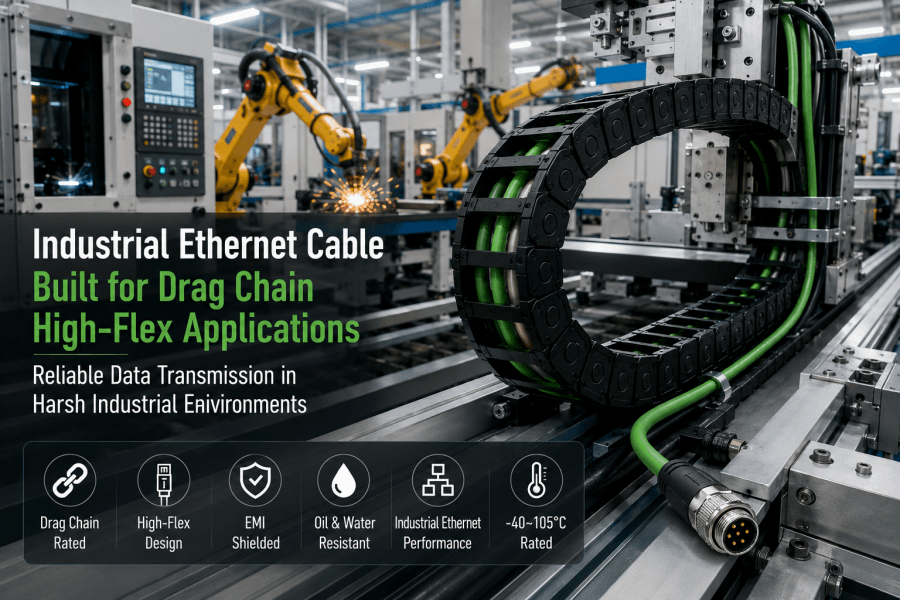
In factory automation, network reliability often hinges on a simple yet critical component: the cable. Standard Ethernet cables may fail prematurely under harsh conditions like vibration, EMI, oil exposure, temperature changes, abrasion, and continuous motion.
I once encountered intermittent packet loss just two weeks after commissioning a production line, and all PLCs, switches, and software seemed fine. The culprit was a standard cable inside a drag chain, which wasn’t designed for continuous flexing. Replacing it with a high-flex industrial Ethernet cable rated for drag chain use solved the problem, highlighting that cable selection is about matching the cable to its operating environment—not just bandwidth or category.
What Makes an Industrial Ethernet Cable Different?
Industrial Ethernet cables are designed for environments where standard Ethernet cables can fail prematurely.
Common applications include factory automation systems, PLC networks, robotics, drag chain systems, machine vision equipment, control cabinets, CNC machinery, and outdoor or semi-exposed industrial installations.
Compared with standard Ethernet cables, industrial Ethernet cables are built to withstand vibration, continuous flexing, oil and chemical exposure, temperature fluctuations, electromagnetic interference, and mechanical stress.
The key difference is not only durability, but long-term stability under real industrial operating conditions.
Why Industrial Ethernet Cable Selection Matters?
In industrial systems, the wrong cable often does not cause immediate failure. Instead, it creates unstable and difficult-to-diagnose behavior over time.
Typical symptoms include intermittent packet loss, unstable signals under load, communication faults during machine movement, repeated downtime, and maintenance issues with no obvious root cause.
In one robotic application, faults only appeared when the arm moved into a certain position. The PLC and servo drive were functioning normally, but the cable had been stressed repeatedly at the same bend point.
Replacing it with a continuous-flex industrial Ethernet cable solved the issue completely. That is why cable selection is often a reliability decision, not just a procurement decision.
How to Choose the Right Cable for Drag Chain?
1. Cable Category
For many factory automation applications, CAT5e is sufficient.
CAT6 or CAT6A becomes more useful when you need higher bandwidth or extra future-proofing, especially in machine vision or data-heavy applications.
Even so, in industrial environments, mechanical durability is often more important than cable category alone. A higher category cable does not solve flex, routing, or EMI problems by itself.
2. Shielding and EMI Protection
EMI is one of the most overlooked causes of unstable industrial networks.
If the cable is installed near motors, VFDs, inverters, welding equipment, or power cables, a shielded industrial Ethernet cable is usually the safer choice.
In real plants, cables that seem stable during commissioning may become unstable once nearby equipment runs at full load. Proper shielding and grounding help improve signal integrity and long-term reliability in noisy environments.
3. Jacket Material
Cable jacket material has a major impact on service life.
PVC is suitable for fixed indoor installations with minimal movement. PUR is generally better for drag chain, robotics, and other high-flex applications because it offers stronger abrasion resistance, better oil resistance, and longer flex life. LSZH is used where low-smoke and fire-safety requirements matter.
For applications involving continuous motion or repeated wear, PUR is usually the more reliable long-term option.
4. Flexibility and Continuous Motion
This is where many installations fail.
There is a major difference between a cable that is simply flexible and a cable that is rated for continuous flex applications. In drag chains and robotic systems, cables bend repeatedly, stress concentrates in fixed areas, and motion cycles can continue for thousands or millions of repetitions.
Standard Ethernet cables may pass initial testing, but they often fail after prolonged movement. If the cable will move continuously, a drag chain Ethernet cable should be treated as a requirement rather than an upgrade.
5. Environmental Resistance
Environmental conditions often decide whether a cable lasts for years or fails within months.
A cable inside a control cabinet may perform perfectly, while the same cable mounted externally on a machine frame can quickly develop cracking, abrasion damage, or communication instability due to oil, moisture, UV exposure, or temperature swings.
In food processing, machining, and welding environments, cables are often exposed to coolant, lubricants, metal dust, and constant wear. In those cases, jacket material and environmental resistance matter just as much as bandwidth or shielding.
Drag Chain Ethernet Cable vs Standard Cable
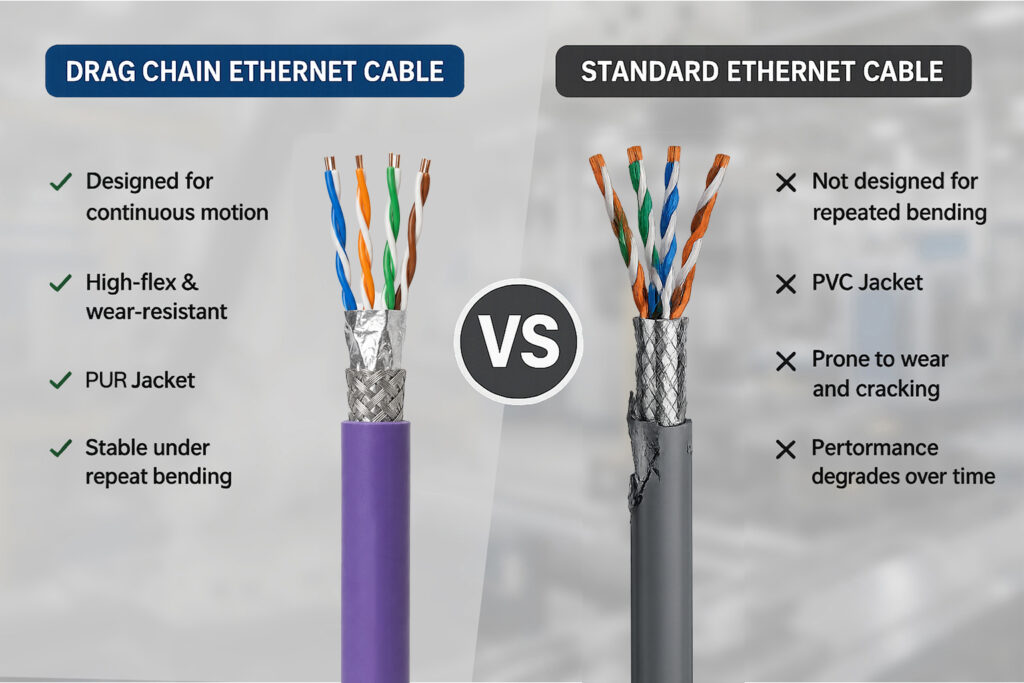
After comparing standard and drag chain Ethernet cables, the next step is determining which type actually fits the application.
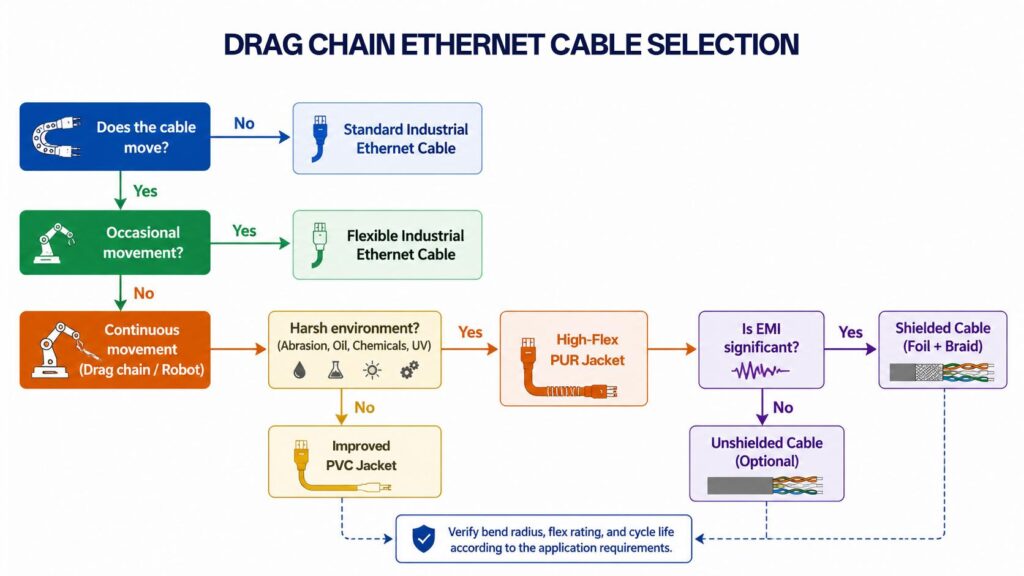
In factory automation, factors such as continuous movement, EMI, oil exposure, and bending stress often matter more than cable category alone. A cable that performs well in a fixed installation may not last long in a robotic or drag chain system.
The simplified selection flow below provides a practical way to evaluate different industrial Ethernet cable applications.
What Industrial Buyers Actually Care About
In most factory automation projects, buyers are usually less concerned about theoretical maximum bandwidth and more concerned about whether the network will remain stable after months of production.
Unexpected downtime is expensive, especially when intermittent faults are difficult to diagnose. Because of that, long-term reliability, resistance to oil and abrasion, shielding effectiveness, and motion durability often matter more than simply choosing a higher CAT rating.
For robotic systems and moving equipment, engineers also pay close attention to flex life, bending performance, and installation reliability inside cable carriers or drag chains.
Working With an Industrial Ethernet Cable Supplier
When applications involve continuous motion, EMI, and harsh environments simultaneously, cable selection becomes more complex.
A reliable industrial Ethernet cable supplier should be able to explain:
- flex life ratings
- drag chain testing standards
- shielding performance
- jacket material differences
- recommended bending radius
- application suitability
Clear technical guidance during selection often prevents expensive troubleshooting later.
FAQ
What is the difference between industrial Ethernet cable and standard Ethernet cable?
Industrial Ethernet cable is designed for harsh environments such as factory automation, robotics, and control systems. Compared with standard Ethernet cable, it offers better resistance to EMI, vibration, oil, temperature changes, and continuous movement.
When should shielded industrial Ethernet cable be used?
Shielded industrial Ethernet cable should be used near motors, drives, inverters, welding equipment, or other EMI sources. Shielding helps reduce signal interference and improves communication stability in factory automation systems.
Can industrial Ethernet cable be used in drag chain applications?
Yes, but only if the cable is rated for continuous flexing. Drag chain Ethernet cables are designed to withstand repeated bending and movement in robotic and automated systems.
What jacket material is best for industrial Ethernet cable?
PVC is suitable for fixed indoor installations, while PUR is better for drag chain and high-flex applications because it provides stronger resistance to oil, abrasion, and mechanical wear.
Is CAT6 better than CAT5e for factory automation?
Not always. CAT5e is sufficient for many industrial automation systems. CAT6 or CAT6A is typically used for higher bandwidth requirements or future network expansion.
Why do Ethernet cables fail in robotic systems?
Standard Ethernet cables are not designed for constant bending and movement. Over time, repeated flexing can damage the conductors and cause intermittent communication failures.
How do I choose the right industrial Ethernet cable?
Consider factors such as motion, EMI exposure, oil resistance, bending radius, installation environment, and required bandwidth. In industrial applications, mechanical durability is often more important than cable category alone.
Conclusion
Industrial Ethernet cable selection has a larger impact on factory network stability than many engineers initially expect.
Choosing a cable that matches the actual operating environment — especially in robotics, drag chain systems, and other moving applications — significantly reduces downtime, communication faults, and maintenance costs.
For continuous motion environments, using a high-flex industrial Ethernet cable designed for drag chain applications is usually the most reliable long-term solution.
References
References