

How Harsh Environments Should Really Shape Your Talk With Fiber Optic Cable Manufacturers

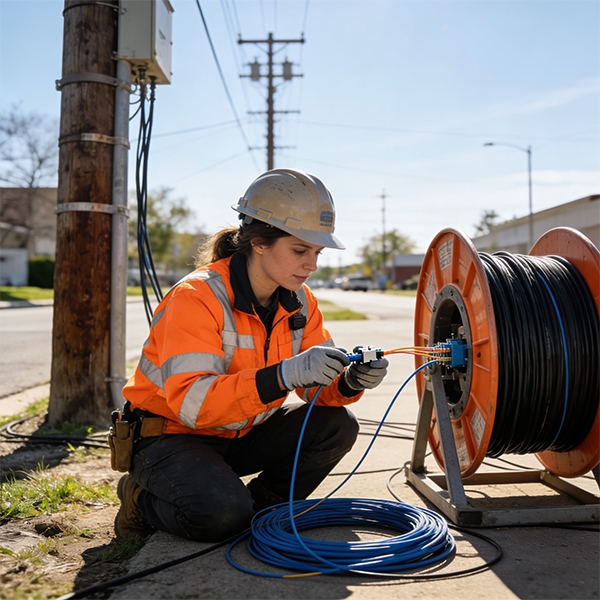
A production shift failed not due to an incorrect bandwidth, but because that environment was neglected. Imagine an engineer who checked only attenuation and speed, identified that the cable met a 10G link budget, and accepted the PO. This cable ran through a hot, humid, oily corridor, and 18 months later, the PE jacket was beginning to crack, allowing water to seep in until one section of the plant went completely dark and was down for the entire shift. This situation did not lead anyone to blame the datasheet, but rather point blame solely at the engineer who approved the incorrect cable.
The true role of the engineer was not simply determining if it would be OM3 or OS2 according to an empty specification sheet. The engineer’s real role was to study the environmental conditions of heat, moisture, chemical vapor, and crushing potential to ensure that the cable structure was matched, even though there may be no computer simulation available. When these criteria were matched, the cable design would not quietly degrade over time from environmental conditions, leading to unscheduled outages.
This publication will provide engineering professionals the tools needed to accurately match the environmental conditions of heat, moisture, chemical vapor, and crushing to fiber optic cable manufacturers by providing easy-to-understand specifications and practical questions. Examples of industrial fiber optic cable, outdoor fiber optic cable, and armored fiber optic cable are provided to aid the engineering professionals in making an informed decision. Most engineers use loss or bandwidth numbers to guide their decision-making, but when using a compliant product, the engineer may be shocked to find out later that the compliant product cracked on a warm wall or swelled in a wet duct.
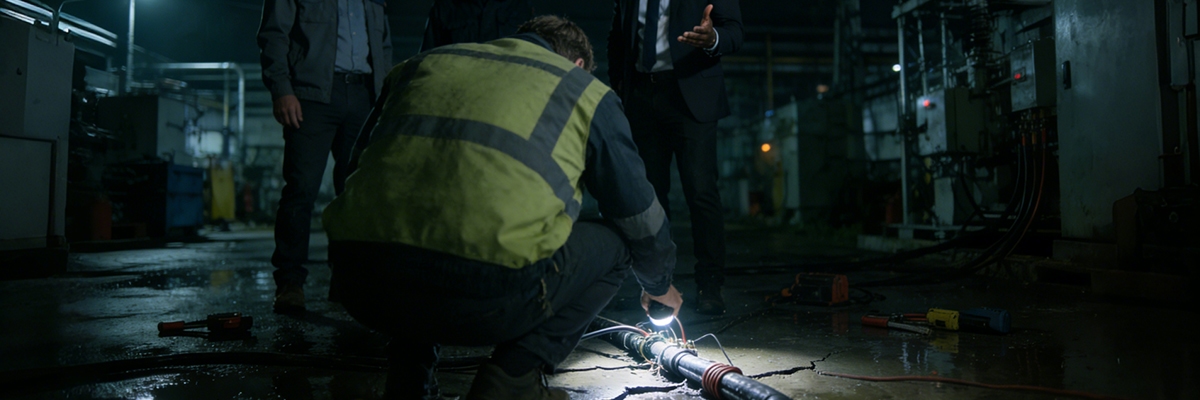
Engineer testing fiber optic cables in a dark, damp environment.
Where Is Your Cable Living? Office Ceiling, Duct, Trench or Pole?
Instead of starting with the fiber type or core count of a cable, investigate where the cable will operate every day, and if you’re unsure of that location, cable manufacturers will have a hard time determining how to make a cable for your application. Most likely, manufacturers will not know if your application is primarily indoor or outdoor, or if it appears to originate from an underground application, so they will tend to provide estimates based on cheaper construction options. Because of the uncertainty regarding the intended location, manufacturers’ estimates will focus on constructing cables that will pass essential optical testing or certifications, at the expense of considering how cables would be placed under real-world stress conditions.
When we change our perspective from that of a manufacturer to that of a product manager, we design a cable family starting with the needs of a home location first, followed by defining the various types of applications to be used with those cables. As a result, by thinking of the specific application types first, we now have very specific applications, i.e., ceiling, duct, trench, and pole, that require very specific materials, protective characteristics, and tensile strengths that correspond to their specific applications. Consider the needs of cables placed in ceiling locations or on riser shafts, as compared with cables placed in a duct or trench.
For example, in the area of a ceiling or riser shaft adjacent to air-handling systems and stairs and emergency exits, the primary concern in this space is fire and smoke, not rocks and rodents. When selecting the appropriate jacketing material for cables placed in ceilings or riser shafts, you should select PVC or LSZH jacketing materials, as these types of jacketing materials limit flame spread and smoke generation while being lightweight and flexible for tight-fitting installations. Think of how cables are run above a drop ceiling in a high-rise building, where HVAC systems are supplying hot air, and the only way to have a low-smoke material in the building is to use PVC and LSZH.
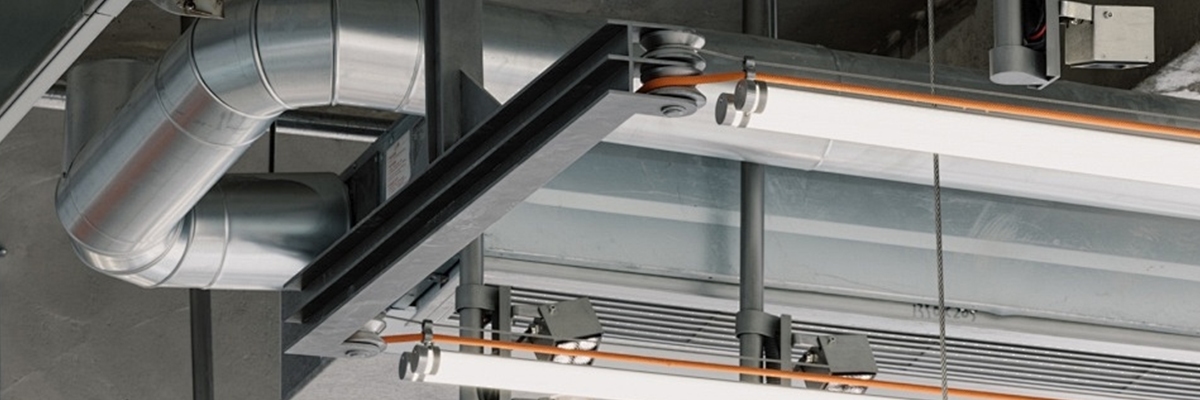 If we were to run cables above drop ceilings made of PVC, any time there is a spark, the spark will create a toxic haze in the hallways, hazardous to all occupants. There will be a possibility that all wall-to-wall fire will occur, stopping the spread of fire with the plastics. Moisture creates stress in cables, creating corrosion and other issues, and increases the amount of pulling and bending necessary to install cables. Therefore, a cable installed in water- and moisture-sensitive applications requires either a jacketing material that is PE (low-VOC, water-repellent), in addition to internal blocking (to stop moisture from getting into the wire).
Imagine the utility duct installed underground below a city street, where water collects during seasonal rains. The only way to prevent water from coming out of the duct is to install PE sheathing and use swelling tape, which prevents water from traveling down the center of the duct and allows the installation to last far longer than that which uses indoor PVC jacketing materials, which becomes soft and will allow moisture to enter. Cables that have been installed in applications where they are near soil, rocks, rodents, and flooding must have jackets (metallic or non-metallic) on top of heavy, industrial PE jackets, with heavy water-blocking barriers.
Consider the utility pole for a power transmission line installed along the highway, where the power lines are located during and directly before and after severe storm events, and weather has created freeze-thaw cycles that can crack inferior jackets. With the PE jackets reinforced, these jackets allow flexing without the fibers being under strain, so they provide long-lasting use in exposed locations, providing a long life for the installation. Because the application location drives how cables are protected from damage, using the appropriate jacket in the appropriate way—e.g., for moisture exposure, PE as a raincoat for outdoor use, and TPU in factories as non-chemical-resistant gloves—allows you to successfully merge your application location with the right jacket for intuitive and reliable choices from the first day of use without having to dive into technical jargon.
From Hot, Wet, Corrosive to Concrete Cable Structures
The assumptions being made by using less than accurate statements or phrases such as “Hot Weather” or “Flood Conditions” become a series of specifications to help steer the suppliers away from making random assumptions, resulting in poorly designed or wasteful products. The specific jacket used to protect each of these risks creates an opportunity to build jackets for these risks and to build inventories already made for use on RFQ & review processes by all members of each team taking part in them. The use of PE (polyethylene) with added water-resistance features to prevent core creep during hot and humid times or included TPUs (thermoplastic polyurethanes) that have been tested against various solvent sprays to allow a factory to apply without causing failure to the jacket assembly.
| Environment Risk | Jacket/Armor Choice | Why It Fits (Expert Tip) | Vendor Red Flag | Cost Impact (Wrong Pick) |
| Office ceiling/riser (fire/smoke) | PVC or LSZH, no armor | Clears escapes fast in air blasts—low smoke certified. | Indoor-only for plenum. | $10K/year smoke remediation. |
| Wet duct/occasional flood | PE + waterblocking (tape/gel) | 20-year submersion shield no core wick. | No block in wet quotes. | 3x initial in swaps/flood fixes. |
| Hot sun/UV (tray/pole) | UV-PE + aramid strength | -40°C to 70°C cycles crack-free. | Basic PE no UV for exposure. | $15K UV cracks/re-runs yearly. |
| Oil/chemicals (factory) | TPU/PUR + light armor | Chem cert ignores lube in 10K flex cycles (Midwest auto saved post-PVC fail). | PVC for oil. | $50K downtime/robot swaps. |
| Rocky trench/rodents (buried) | PE + corrugated steel tape | 10kN crush/bite from digs—rodent-proof. | Non-armor rodent soil. | $30K digs/outages per breach. |
| Harsh mine (flood/debris) | PE + steel wire armor + full block | GR-20 vibe/soak/5-ton (Nevada $200K/year post-duct shred). | Light duct tunnel flood. | 4x life in repairs/hauler stops. |
| Wastewater (corrosive/UV) | UV-PE + chem inner layer | IP68 beats H2S splashes sensor steady. | Riser damp chem. | $25K sensor fails/clean cycles. |
Dust, vibration, and flood conditions are common in mines (mining) – extreme conditions that occur in the equipment and environments. One example of protection from the heavy weight of equipment is using PE (polyethylene) wire armoring (a combination of layers of polyethylene with different levels of flexing ability) to protect from extreme conditions that mines may experience. Another advantage of PE wire armoring is that it maintains structure while allowing enough flexing for carrying and is significantly more affordable than PVC (polyvinyl chloride) used with lubricants.
An example of this is in a Nevada mine operation where they replaced conventional light fixtures with PE in an area where debris was puncturing the lights, resulting in $200,000 per year in costs. Key points from the case studies are that resin must be lubricated prior to installation to protect against premature moisture buildup and that PE wire armoring will act as a buffer between two surfaces that rub together. Additionally, both examples of resin and PE wire armoring have been used to add another layer of protection to the equipment and provide increased protection for laborers.
 When Good Cables Die Young: The Hidden Cost of Install Mistakes
 When Good Cables Die Young: The Hidden Cost of Install Mistakes
Perfect matching systems can break due to improper handling. As an example, a perfect match can be pulled over a corner exactly like a kinked hose or jammed tightly together, which can cause additional errors in areas of high stress and could cause pulling force to become a problem in the future. To assume that contractors know their limits is dangerous; the amount of electrical current they use for installation creates risks, so treat the installation process as the “environment tail” for the equipment you are installing by using on-site indicators to help protect the installation and avoid credit for any mistakes or issues.
For example, if zip ties are pulled extremely tight, the members of the ladder racks can be pinched. There is no space between the outer jacket of the cable and the zipper that is not being used; if a member of the rack sinks more than 0.5 mm below the jacket of the cable, or if you cannot fit a single finger underneath the jacket of the cable and the zipper, you need to loosen the zipper now. If you do not loosen them at this time, you are creating a slow crush that will create microbends during thermal cycles.
Drums that are dragged across gravel could cause damage to the outer jacket of the cable when they are put into service. While the cable is protected from deflection by the outer jacket, dragging a drum around by hand can cause damage to the jacket and result in a 20% reduction in the life of the cable. Similarly, cables that are installed in duct systems should not be placed with any slack because when ice builds up in the cable, it can create internal tension that can ultimately cause it to fail.
To protect against the possibility of cable damage due to installation at angles or static, the original cable specifications should be marked or recorded so that they remain in place for a long period of time. There will always be situations where a team of installers is dragging cables without the use of pulleys; this should be stopped because of the potential to rip the outer jacket of the cable and damage the insulation, which is indicated by the presence of grit on the jacket. When trenching backfills and the rocks are removed, a dent check should be done on the cable.
An undamaged outer jacket will indicate that it was able to survive under traffic; using zip ties on cables every 1 to 1.5 m with a loose fit will help prevent pinch points that would increase your annual losses. Using aerial sag calculations can help you avoid the maximum sag distance during storms. A supervisor’s visual inspection will also help to confirm that the design was properly executed in the field.
The visibility of missing cable ties or drag injuries should highlight the fact that mistakes were made in the design process and that every day should be considered an opportunity to learn and create new opportunities in the future.
How to Brief Fiber Optic Cable Manufacturers So They Stop Guessing
 How to Brief Fiber Optic Cable Manufacturers So They Stop Guessing
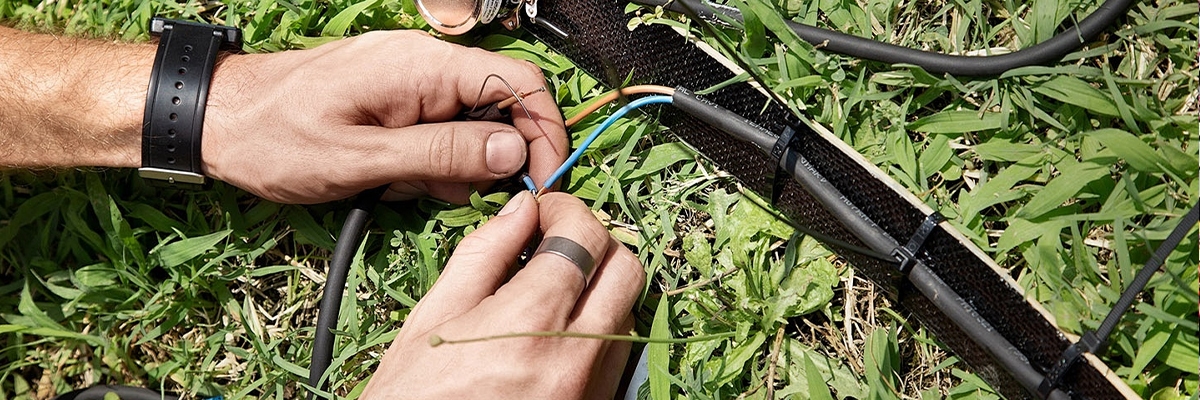
Cheap generic vendors tend to overlook water intrusion and hydrocarbon contamination, resulting in an ambiguous product offering – 24 cores singlemode outdoor. The installation method is listed as deployment duct trench; however, the ambient temperature range is 40–70 degrees Celsius. The product’s failure point is water and hydrocarbon contamination. The average life of the product is 15 years.
For more information regarding the life of the product, see Layer 1-3 of the GR-20 (a national standard of the American National Standards Institute) and IEC 60794 Series. Plain text provides more information than lists and will provide you with an opportunity to reach out to the supplier of the product for confirmation of the information provided. Each supplier will have quoted you a true match to your product, along with a list of their proven survivability methods.
Five RFQ Sentences That Make You Sound Like a Pro
Outdoor routes with buried ductwork that experience occasional flooding use both PE-jacketed and waterblocking GR-20 wet equal. Industrial applications where the ducting services oil mist lines require TPU Chemically Resistant jackets, and temperature data that relates to the oil must be provided. Conduits that are buried directly in rock and those where rodents are present should have metallic or nonmetallic armour for crush protection and provide sufficient OSP space for blocking trench length requirements.
To provide clear passageways from ceiling risers into the elevated plenum risers, the ceiling must be UL and NFPA approved for both flame and smoke expansion. Maximum pull and bend of four 90°bends from 50 mm conduits at 120 m of indicated test limit datasheet certification.
Before You Hit Order: Spotting Misconfigurations on Paper
 Before You Hit Order: Spotting Misconfigurations on Paper
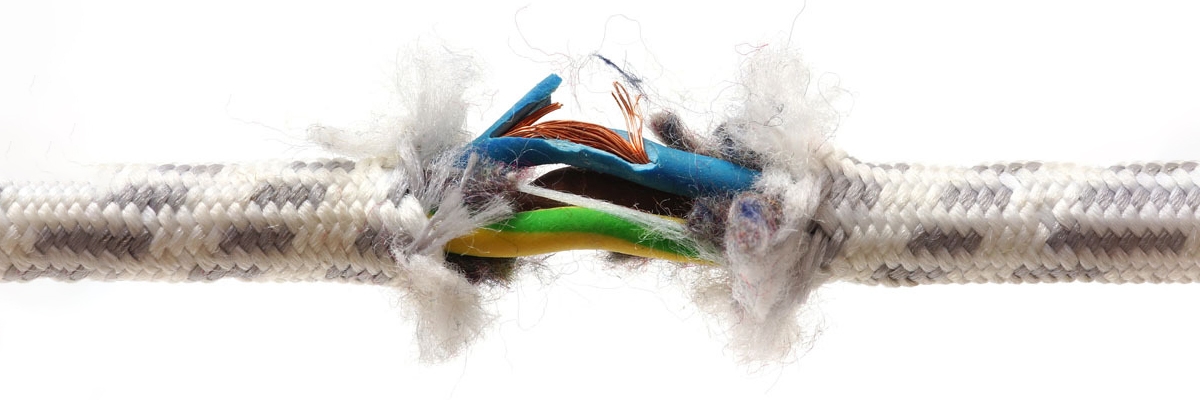
Quotes show fiber mode but want to compare jackets vs structures, so risers for well ducts? Requires OSP PE block. Rocky, no armor and bury? So steel tapes shall be required. Rooftops exposed to UV would result in cracking.
No floods? There are potential paths for floods to be created. Three Red: indoor chemical plants that use PVC ducts in oil plants also use light trenches for rodents Aerial for non UV ducts. Using a minutes scan to get ahead of any digging problems is less of an issue than traditional methods.
How This Workflow Reduces Blame, Rework and OverDesign
Bandwidth-led picks go bust under real world conditions. But starting from scratch at the crib, taking flat file maps to jackets and armor, matching standards to radius regimes, talking everyday briefs, and combing quotes leaves us outage-free. Armor goes where the rocks plead. Ducts take PE, no frills.
That checks the site to the body: we get the same factory test-ready cables everywhere instead of repeating runs, neither needing special skills, just a crisis yarn or two, decent trolley barrels, and boss smartness to turn out a real handbook for the digging job.
Reference Sources
- Generic Requirements for Optical Fiber and Optical Fiber Cable (Telcordia GR‑20): Overview of mechanical and environmental requirements (tension, crush, water penetration) for outside‑plant fiber optic cables used in ducts, trenches, and aerial routes.
- Understanding Fiber Optic Cable Jackets and Fire Ratings: Explains how PVC, LSZH, and PE jackets are selected for plenum, riser, and outdoor locations, and clarifies flame and smoke requirements for ceiling and shaft installations.
- Industrial Fiber Optic Cables for Harsh Environments: Manufacturer guide showing cable families for mines, factories, and outdoor plant, including PE jackets, steel armor, and water‑blocking structures matched to specific environmental hazards.